
Public preview · Pending editorial review
The dashboard is green. Why is the new hostname missing?
A healthy DNS control plane does not guarantee that a saved record has reached authoritative servers or the resolvers your users depend on. Cloudflare's new account of its DNS probes offers a practical way to detect the gap before it breaks a release.
In this story

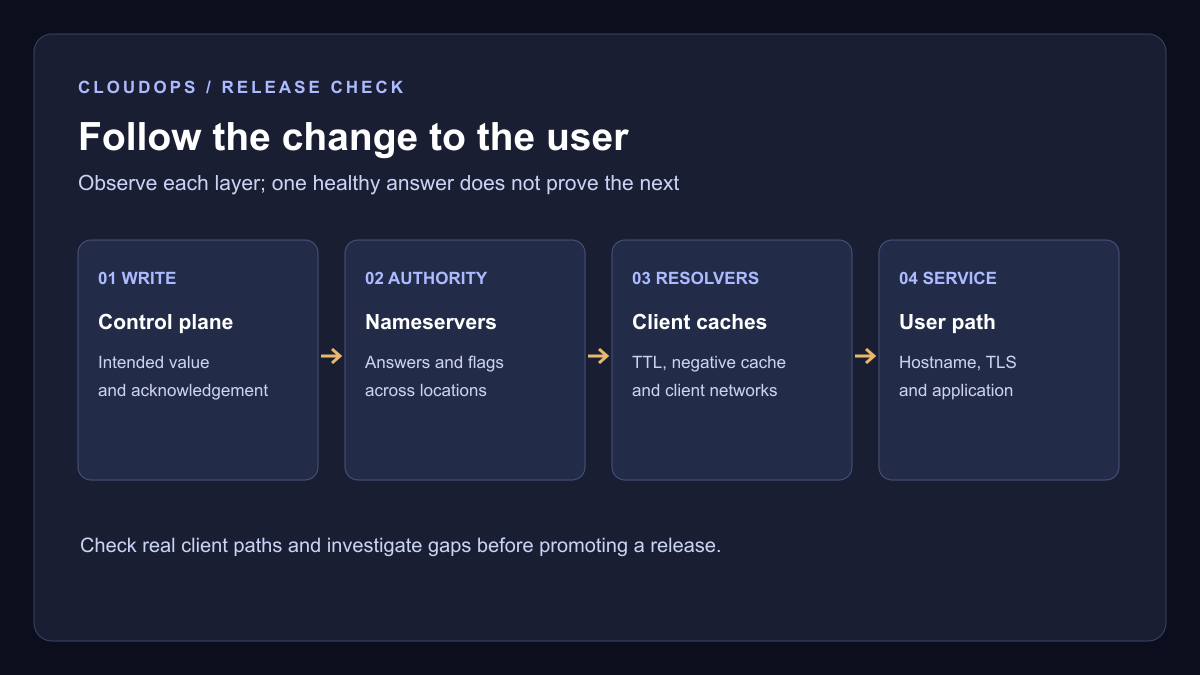
Follow the change to the user
A saved record is the start of verification, not the end.
- Write
Record the intended value and provider acknowledgement.
- Authoritative
Compare nameservers, flags, answers and locations.
- Recursive
Check representative resolvers and cache behavior.
- Service
Verify the client path, TLS and application health.
Saved is not the same as visible
On 23 November, Cloudflare described how it tests DNS propagation across its edge. In a past rollout, a scheduling bug left some DNS record changes unpublished for hours while the service remained healthy. New hostnames were slow to resolve, and certificate issuance could not proceed until the bug was fixed. The article does not date that incident; it is an example, not a claim that the outage occurred this week. [1]
This matters beyond one provider. A successful API response is evidence that a control-plane request was accepted; it does not, by itself, establish what an authoritative server or a recursive resolver will answer from a particular location. For a time-sensitive cutover, that distinction can be the difference between a clean release and a long conversation with the certificate team.
What Cloudflare actually measures
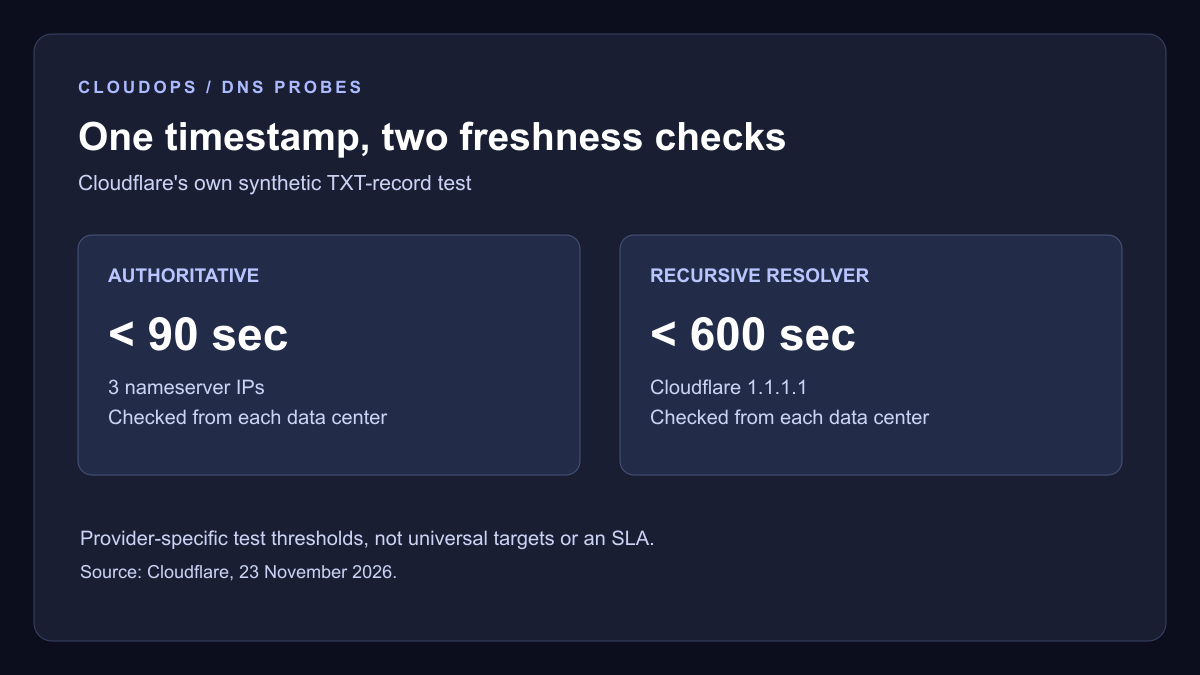
Cloudflare says its internal Flamingo tests repeatedly update a TXT record containing a timestamp, then query three authoritative nameserver IPs and the public resolver 1.1.1.1 from each of its data centers. Its checks expect the authoritative answer to be less than 90 seconds old and the resolver answer less than 600 seconds old. These are freshness thresholds in Cloudflare's test, not a universal DNS SLA or a guarantee for every customer record. [1]
The authoritative example checks the response code, the authoritative-answer flag and the TXT value's freshness. The team uses the resulting service-level indicators to inform rollout decisions, including halting or rolling back changes. This is a provider's description of its own system, not an independent measurement of all DNS services. [1]
Separate the layers before blaming propagation
First confirm the intended value, name, record type, zone and successful write in the DNS provider's control plane. Then query the relevant authoritative nameservers directly and record the answer, response code, TTL and flags. Compare the results across the published nameservers and independent locations where you can; a single anycast IP observed from one location is not a view of every edge. Check delegation and DNSSEC validation when responses disagree or fail.
Next query the recursive resolvers used by real clients, including corporate or regional resolvers where applicable. Cached old answers may persist for their TTL, while a previously missing name or record type can also be negatively cached. RFC 2308 describes negative caching of non-existent names and missing record sets; resolver behavior and configured limits matter. A clean answer from one public resolver does not prove all users see it. [2]
Finally check the actual user path: does the expected hostname resolve from the client network, does TLS validate for that name, and does a safe application health request reach the intended service? DNS correctness is necessary for many releases, but does not prove that the application or certificate is healthy.
Build a small canary, not a new outage
Use a dedicated probe name in a zone you control, with a single writer, limited credentials, a bounded update rate and a documented owner. Do not repeatedly overwrite production service records to run the test. Publish a monotonically identifiable value or timestamp, log the acknowledged write time, and record observations per name, record type, nameserver or resolver, vantage point and UTC time. If age comes from timestamps, keep clocks synchronized and measure clock skew.
Track authoritative and recursive paths separately. Choose alert thresholds from observed distributions, provider behavior, TTL and negative-caching policy, plus the time your release can tolerate. An old answer can be expected within its cache lifetime; a slow authoritative update, DNSSEC failure, or unreachable nameserver calls for a different investigation. Alert on sustained failures or burn rate with a clear owner, and test the rollback or pause decision before automating it.
A canary is evidence about its own record and path, not proof that every zone, record type, resolver or application is healthy. Pair it with deployment-specific checks for the actual hostname and authorized end-to-end monitoring.
Five checks for the next release
Start with an inventory and read-only queries. Restrict any active probe writes to an approved dedicated record and follow your change and rate-limit policies.
- List critical hostnames, authoritative DNS providers and nameservers, resolver paths, TTLs, certificate dependencies, owners and expected values. Note split-horizon or private DNS separately.Evidence: A dated map of the real client paths and named owners, with unknown dependencies marked.
- After an approved change, record the provider acknowledgement and compare responses from each relevant authoritative nameserver and more than one suitable vantage point. Capture response codes, flags, answers and TTLs.Evidence: A timestamped record of the intended value and observations by nameserver and location.
- Query representative recursive resolvers and client networks; compare old and new answers against the previous TTL and negative-cache behavior. Investigate DNSSEC or delegation failures rather than treating every discrepancy as normal cache delay.Evidence: A resolver-by-resolver timeline with expected expiry, errors and coverage gaps.
- Check the actual service path using authorized DNS, TLS and application health probes, especially before certificate issuance, failover or a cutover. Escalate when the change exceeds the agreed window or users are affected.Evidence: Hostname-specific reachability, certificate and application checks linked to the change record.
- If recurring synthetic probes are appropriate, use a dedicated record, bounded writes, synchronized clocks and least-privilege credentials. Baseline separately for authoritative and recursive checks, then rehearse alerting and a safe deployment pause.Evidence: Probe ownership, scope, retention, thresholds, alert routing and a tested response runbook.
A green check is a useful witness, not a verdict
The Cloudflare measurements are synthetic checks against a specific probe and set of targets. They cannot establish that every customer's change propagated everywhere, and their thresholds should not be copied blindly. TTL expiry is not a promise that every resolver or client refreshes at the same instant; record actual observations and investigate exceptions. [1]
Research window: 20–26 November 2026 UTC. The 23 November engineering article is the weekly trigger; the rollout example is undated. DNS may be innocent this time, but the dashboard should at least let it testify.
Sources and limits
- Cloudflare: Probing DNS at Cloudflare 23 November 2026. Provider account of DNS freshness probes, an undated rollout issue and release gates.
- IETF RFC 2308: Negative Caching of DNS Queries Standards background on caching non-existent names and record sets.
- IETF RFC 1035: Domain Names — Implementation and Specification DNS message formats, response flags and TTL background.